
When you and your partner live apart, because of work, study, travel or migration, you cannot simply reach for each other. Many couples look for other ways to say "I miss you". A survey of people in long-distance relationships found that touch-adjacent gestures were very common, but it cannot show that they replace being together or make a relationship better.
The study, from Mitala, Dickerson and Jakubiak, appeared online in the Journal of Social and Personal Relationships, dated 25 August 2026. The researchers surveyed 499 adults recruited through the online platform Prolific in autumn 2024. Eligible participants had to be in a romantic relationship of six months or more, and to have been apart from their partner for a month or longer.
It was a preregistered, descriptive survey answered online. The published summary does not say which country or countries the participants lived in.
The team asked about what they called touch-adjacent behaviours. Mimed touch meant symbolic gestures such as blowing a kiss on a video call. Expressed touch meant telling a partner that you wanted to hug them. Neither provides physical contact. They communicate a wish for it. The survey also asked about perceived compensation for distance, other affectionate behaviour, relationship maintenance and attachment.
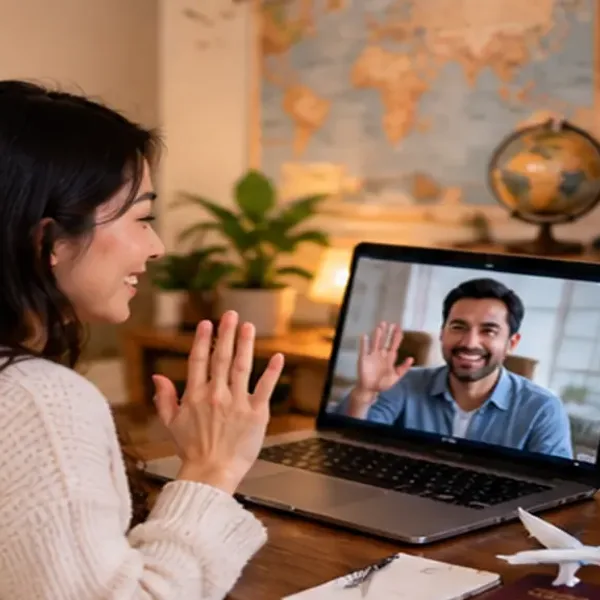
The gestures were reported by nearly everyone. Almost 95 per cent (94.5) said they sent mimed touch, and 91.9 per cent said they received it. For expressed touch, 99.0 per cent reported sending it and 98.6 per cent reported receiving it. These figures describe this particular sample. They do not tell us how common the behaviours are among all long-distance couples.
Use of the gestures went hand in hand with other affectionate and relationship-maintenance behaviours, with lower attachment avoidance and with better relationship quality. Receiving the gestures was more strongly tied to relationship quality among people scoring higher on attachment avoidance, while attachment anxiety made no difference to the association.
An exploratory analysis added an important caution. Once other affectionate behaviours were accounted for, these gestures no longer predicted relationship quality on their own. In plain terms, the gestures usually appeared alongside other signs of care. The survey did not show that a symbolic kiss, or a message about wanting a hug, was the reason a relationship felt stronger, or that these gestures outperform other ways of showing affection.
A descriptive survey cannot tell which way an association runs. Perhaps people who feel closer use these gestures more, or perhaps both are tied to some third factor. It also cannot show that mediated gestures replace physical touch or meet every need that distance creates.
The behaviours asked about were not a full list and may have omitted sexual forms of connection, so the picture is partial. The people who answered were volunteers on an online platform, which may differ from other long-distance couples.
The finding invites you to notice how partners show warmth while apart; it is no scorecard for how affectionate a long-distance couple should be. If you and your partner live apart, you could ask, "Would a video call, a voice message or a small affectionate gesture feel good to you this week?" Some people like a kiss blown at the camera, while others would rather get a kind message or talk about when you will meet next. Treat these as ideas to discuss; the study did not show them to be necessary or effective for every couple.
Talking about what feels meaningful works better than assuming your partner enjoys what you enjoy. A symbolic gesture still communicates something, and it ought to be welcome. A survey like this should never be used to push someone into affectionate exchanges, or to imply that a partner's preferred way of connecting falls short. One partner might say they are missing closeness and ask whether a voice message or a planned call would suit the other person better. Offering a choice like this respects what each person wants. Together you can pick one easy option, or agree that neither of you wants anything added.
Source: Journal of Social and Personal Relationships article on mimed and expressed touch in long-distance relationships (title not retrieved) DOI: 10.1177/02654075261481218
Illustration of communicating affection in a long-distance relationship. AI-generated editorial illustration. This article summarises published research in our own words and is general information, not personal health advice.

Please Login or Sign up to be able to comment