Everyone knows the feeling of meeting someone and simply clicking. Scientists are asking what happens in the brain when animals form friendship-like bonds, and a 2025 study in prairie voles offers some clues. This is animal research. It does not show how human friendship works, and it is not a reason to expect anything from products that claim to act on oxytocin.
The study, "Oxytocin receptors mediate social selectivity in prairie vole peer relationships", was published in Current Biology on 8 August 2025 and reported by ScienceDaily a few days later. It came from a team at the University of California, Berkeley, including Annaliese Beery, with collaborators at the University of California, San Francisco.
The animals were prairie voles, small rodents that form lasting pair bonds and also form friendship-like attachments with peers. The researchers compared typical voles with genetically modified voles that lack oxytocin receptors, the docking points through which the hormone oxytocin acts. Oxytocin is sometimes called the love hormone, but earlier work by the same collaboration found that voles without these receptors can still form mate bonds.
This study looked at peer bonds instead. The team ran three behavioural experiments and one brain measurement. They tracked how long voles needed to come to prefer a companion they had lived with over a stranger. They placed long-term pairs in a larger space with other voles to see whether they kept track of their original partners. They tested how hard voles would work, by pressing a lever, to reach a friend, a mate or a stranger. And they used a carbon-nanotube sensor developed in a Berkeley lab to measure oxytocin in the brain.
Typical voles showed a clear preference for a companion within about 24 hours. Voles without the receptors showed no preference at 24 hours, and most had formed bonds by about one week. The authors concluded that oxytocin signalling is not required for a relationship but speeds up its early formation.
In mixed groups, typical voles kept track of their partners, while the modified voles mixed with others without regard to who their original partners were. In the lever-pressing test, the modified voles pressed the lever for their mates but not for their peers, which suggests peer bonds may rely less on the brain's reward pathways than mate bonds do. The lever-pressing results were described for female voles.
The modified voles were also less aggressive and less avoidant towards strangers. The authors suggest that oxytocin signalling supports both a preference for familiar individuals and wariness of unfamiliar ones. The brain measurements did not show an excess of oxytocin in these voles. Instead, release was lower and came from fewer sites in the nucleus accumbens, a region involved in social reward.
This is a study of voles, not people. Friendship in humans involves language, history, culture, shared values and choice, and nothing in this work tells us how those things relate to oxytocin. The source describes applying the findings to human conditions as a future research direction, not an established link. The findings do not show that oxytocin levels explain why you click with a particular person, and they do not show that anything taken or sprayed to raise oxytocin would help friendships. This article does not suggest any product or treatment.
The voles lacked the receptor from birth, so their brains may have adapted in ways that the report does not address. The report does not give the number of animals, the sex of the animals in every experiment or the full statistical details, and it has no formal limitations section. Studies on other vole species and other animals are described as ongoing or early.
What the study does offer is a reminder that connection is not all or nothing. In these voles, bonding still happened without the receptors. It was slower, and more indiscriminate. For curious readers, it is an interesting piece of basic biology about why an animal might bond more quickly with some individuals than with others.
If you find it hard to form or keep friendships, that is common and has many causes. A GP or a qualified counsellor can talk it through with you.
Source: Oxytocin receptors mediate social selectivity in prairie vole peer relationships DOI: 10.1016/j.cub.2025.07.042
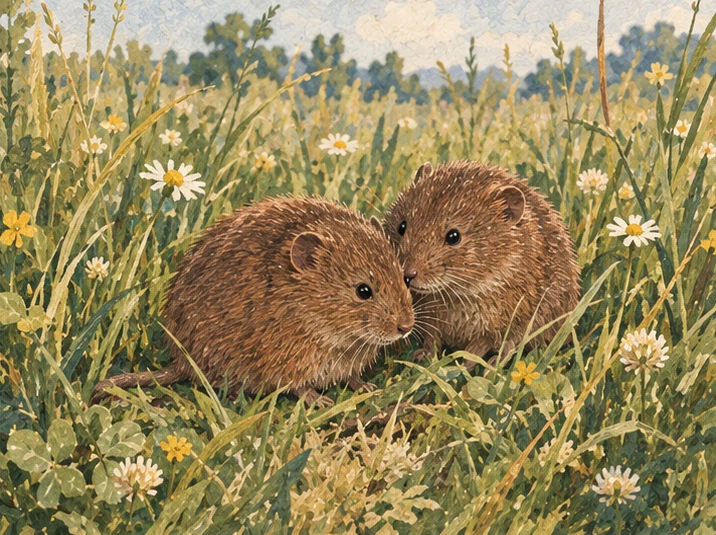
Illustration of prairie voles, the animal model discussed in the peer-bonding article. AI-generated editorial illustration. This article summarises published research in our own words and is general information, not personal health advice.

Please Login or Sign up to be able to comment